CV values in hatcheries – useful or not?
Tags: Hatching | Whitepaper
, 8 September 2026
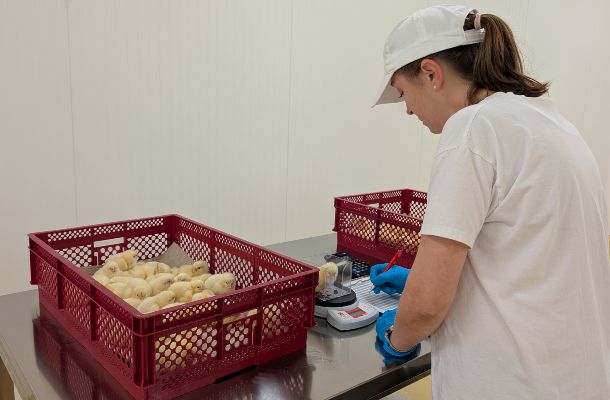
Uniformity is very important in the poultry sector, including hatcheries, as it makes production more efficient and predictable. One way to measure uniformity is using CV values. CV stands for ‘coefficient of variation’ and can be used as a quality indicator for uniformity. It is used on farms to measure the quality of the brooding period, but can also be used in hatcheries.
Why use the CV in a hatchery?
The CV can be calculated for a group of eggs or chicks. A low CV value represents low variation in weight and high uniformity, so the higher the CV, the higher the variation. In hatcheries, the CV can be used for quality control and to identify possible issues in breeder flocks. A sudden increase in the CV for egg weight can point to problems at the breeder farm, for example. It can also be used to quantify uniformity, and therefore to compare uniformity between breeder flocks. An increase in chick CV can point to incubation-related issues, such as a larger hatch window. On the other hand, hatcheries can provide broiler farmers with a CV for the delivered batch, which can then be used as a starting point for the brooding process.
How do I calculate the CV?
The minimum required sample is 100 eggs or chicks. These eggs or chicks need to be individually weighed, which requires good quality, sufficiently accurate scales (±0.5g) to avoid measuring mistakes. A sample should be taken from a single batch of eggs or chicks, and random samples taken from different trays or baskets. The individual weights of at least 100 eggs or chicks are recorded, and the formula below used to calculate the CV value.
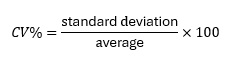
The easiest way to calculate the standard deviation is using Excel. Enter the individual weights, calculate the average and standard deviation, and enter these values into the formula.
When should I take a sample?
If the CV is calculated for eggs before setting, this says something about the uniformity of the egg weight. It can also be calculated for a sample of chicks during chick pulling or after selection. Note that the CV value for chicks will always be higher than that for the eggs. One reason for this is the large individual variation in water loss during incubation between eggs. Furthermore, differences in hatching time mean that early hatchers lose more weight due to moisture loss through respiration than late hatchers. Note that, if the CV of chicks is calculated before selection, it will probably be slightly higher than after selection as poor quality and very small chicks are removed during the selection process.
How do I interpret the results?
Universal benchmarks for the CV in hatcheries are difficult to find because CV values are mostly used in broiler farms. Here, a CV of 7% at day 0 is considered excellent. It is recommended to develop hatchery-specific normal CV ranges for the breeds used in the hatchery and for different flocks and flock ages. Always use flock age as an indicator for this range, as uniformity is influenced by the age of the breeders.
To conclude, while not yet commonly used in hatcheries, the CV value can be a useful tool for quantifying the uniformity of egg and/or chick batches.
Advice
- Do not measure eggs or chicks from only one basket or tray, but take random samples of that batch.
- Use the CV to compare the uniformity of batches of eggs and chicks.
- Develop hatchery-specific benchmarks for the CV.
Written by Lotte Hebbink
Incubation specialist
I welcome your feedback on this article - and if you require any additional information, please don't hesitate to contact me.