The ins and outs of measuring eggshell temperature
Tags: Incubation | Whitepaper
, 6 October 2025
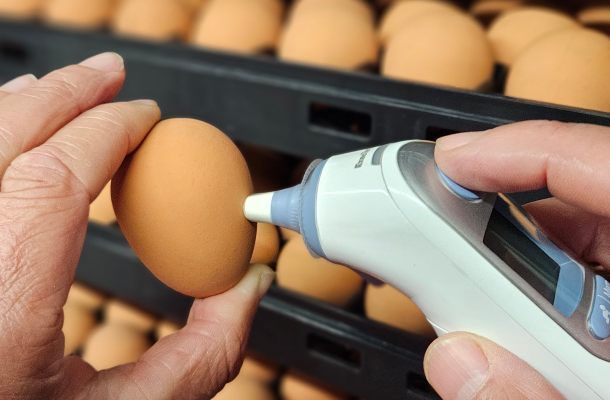
Gone are the days when hatchery managers talked only of incubation temperature. They simply placed the hatching eggs in an incubator and selected the temperature set points that had worked before. However, there are several reasons why it is better to base incubation on embryo rather than set point temperature, which only controls the temperature of the circulating air.
Eggshell temperature is the way to go!
Reasons for not using set point temperature include:
- the temperature sensor might show electronic drift and give faulty readings;
- the temperature set points might work in one brand of setter but not in another;
- different batches of eggs (breed, size, fertility) might require different temperature set points.
As embryos cannot control their own body temperature (as they act as poikilotherm, or ‘cold blooded’, organisms), the temperature set points should be based on the body temperature of the embryo (ET), which is ideally 37.8°C/100°F. And, as we cannot measure the ET without damaging the egg and killing the embryo, it is now common practice to measure eggshell temperature (EST), which provides a fair reflection of the ET.
How to measure EST?
There are several considerations:
- Device: Different devices give different results. The Braun ThermoScan, an infrared ear thermometer designed for use on humans, is commonly seen as the reference, while other brands may show a considerably lower or higher EST. Note that, at least in the endothermic phase (roughly up to day 12 of incubation), the Braun ThermoScan measures approximately 0.4–0.5°F higher than the ET measured with a veterinary thermometer. The use of data loggers, whereby the sensor is attached to the eggshell, is becoming increasingly common. These measure continuously and give a clear graphic overview of EST during the entire incubation cycle.
- Air flow: Air flow has a considerable effect on EST, especially in the exothermic phase (roughly after day 12 of incubation). A temporary interruption of air flow, for example when stopping the setter or even driving a trolley out for measuring, will result in a fast increase in EST. Note that levelling the trolleys in order to reach the eggs in the centre of the tray also influences air flow.
- Egg: Measuring during the exothermic phase at the blunt end of the eggs, where the air cell is located, results in an underestimation of EST. Also, infertile eggs and eggs containing dead embryos do not produce metabolic heat and will therefore show an unrealistic EST.
- Location: Not all eggs in the same incubator will have the same EST, again especially during the exothermic phase. Eggs at the centre of the tray will be warmer than those at the edge, and eggs close to the fan will be colder than those at locations with a lower air flow.
Advice:
- Use EST to fine-tune temperature set points for optimal incubation, , but hatch results – including chick quality – should always be the leading parameter.
- Interpret the measured EST with care; understand that different devices give different results.
- Use more than one device to occasionally compare temperatures on the same egg or in the same environment, to confirm the correct working of your device.
- Place the sensor at the equator or shoulder of the eggs; not on the air cell.
- Measure EST at different locations within the setter, trolley and tray.
- Measure EST either in a running setter or during the few minutes directly after the setter has been stopped.
- Ensure the probe or sensor makes full contact with the eggshell and is not directly affected by the circulating air.
- Exclude ‘cold’ eggs (infertile or dead embryo) from calculating the average EST; use a candling light to confirm when in doubt.
- When using the Braun ThermoScan:
- prewarm in a running setter for approximately ten minutes before use;
- understand that during approximately the first 12 days of incubation, an EST of 100°F equals an ET of 99.5–99.6°F.
Written by Gerd de Lange
Senior Poultry Specialist
I welcome your feedback on this article - and if you require any additional information, please don't hesitate to contact me.